
Is Handwriting Analysis Scientifically Valid? What Research Says
Is handwriting analysis scientifically valid? Explore forensic evidence, graphology myths, and real accuracy rates backed by research studies today.
Published on March 18, 2026
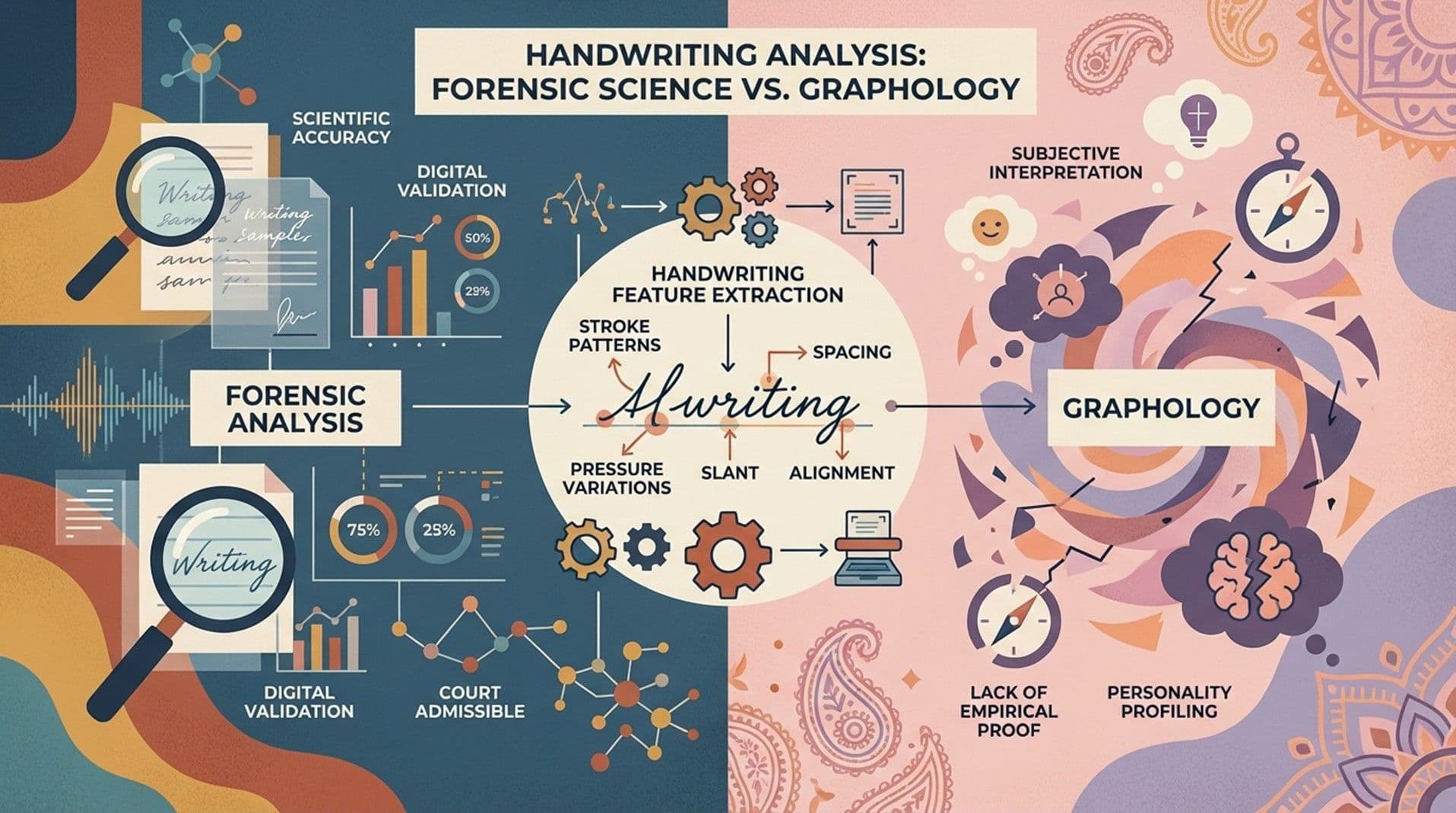
You've probably seen handwriting analysis in crime shows or heard someone claim they can read your personality from your penmanship. But here's what most people don't know: there are actually two completely different types of handwriting analysis, and science has drastically different things to say about each one.
Let's be real. When you hear "handwriting analysis," you might picture a graphology expert examining loops and slants to reveal if you're ambitious or anxious. That's graphology—and spoiler alert, the research isn't kind to it. But forensic handwriting examination? That's a different story. We're talking about comparing writing samples to identify who actually wrote something, and the data here gets interesting.
The Science Behind Handwriting Uniqueness
First things first: Is everyone's handwriting truly unique? According to research from the University at Buffalo, the answer is yes. Scientists analyzed 1,500 handwriting samples, examining 11 structural features and 512 character-specific features. Their conclusion? They could distinguish between different writers with 96% confidence.
Think about it this way. Your handwriting is like your fingerprint, shaped by years of muscle memory, pen grip, and writing habits. No two people form letters exactly the same way. This study, funded by the National Institute of Justice, was actually the first peer-reviewed validation of handwriting individuality—and it's been cited in federal court cases.
But here's where it gets technical. Researchers used computer software to extract features that the human eye might miss. Stroke patterns, spacing consistency, pressure variations. Stuff that goes way beyond just looking at whether someone's 'a' is round or pointy. This applies equally to full handwriting samples and signature analysis, where individual characteristics become even more concentrated.
What Forensic Studies Actually Show
The largest-scale validation came from a 2022 study published in PNAS. Researchers tested 86 professional forensic document examiners on 7,196 comparisons. The results? Pretty solid, but not perfect.
On matched samples—where the same person wrote both documents—88.3% of examiner conclusions aligned with the truth. They got it right more than 8 out of 10 times. But examiners didn't just say "yes" or "no." They used a five-level scale: Written, Probably Written, Cannot Determine, Probably Not Written, and Not Written.
Here's what matters. Only 54% gave a definitive "Written" conclusion on matched samples, while 34.3% said "Probably Written." Experts tend to be cautious. Smart move, honestly.
For non-matched samples, 77.4% of conclusions were accurate. But—and this is important—7.9% of non-matched trials got flagged as possibly or definitely written by the same person when they weren't. False positives happen.
Graphology and Personality Assessment: The Reality Check
Now let's talk about using handwriting analysis for personality assessment. You know, the claim that your handwriting reveals if you're extroverted, neurotic, or conscientious based on the Big Five personality model. Many people seek graphology consultation hoping to gain insights into character traits, but what does the science actually say?
Studies examining graphology for personality assessment found low validity. Researchers tested whether handwriting features correlated with established personality traits, and the results were disappointing. The connections just weren't there in any meaningful way.
One computerized analysis model claimed 93% predictive accuracy for personality traits using 1,066 samples. Sounds impressive. But here's the catch: this was a proposed model, not established scientific practice. It hasn't been widely replicated or validated by independent researchers.
Despite numerous graphotherapy books claiming transformative results through handwriting modification, the empirical evidence doesn't support personality change through altered penmanship. Bottom line? If someone tells you they can diagnose your personality from your handwriting or signature, they're relying on pseudoscience.
Signature Analysis: Where Science Meets Graphology
Graphology signature analysis deserves special attention because signatures occupy a unique space in handwriting analysis. From a forensic perspective, signature analysis is scientifically valid for authentication purposes. Banks, legal documents, and contracts rely on signature verification daily.
However, when graphology experts claim they can assess personality traits specifically from signature analysis, the scientific support evaporates. Your signature might be bold or minimal, elaborate or simple—but these characteristics don't reliably predict psychological traits despite what popular graphology consultation services might promise.
Why Courts Sometimes Reject Handwriting Evidence
Legal standards matter. In U.S. courts, expert testimony needs to meet the Daubert standard—it has to be scientifically valid and reliable. The Buffalo study actually helped handwriting testimony get admitted in U.S. v. Gricco because it provided peer-reviewed validation.
But not all handwriting analysis passes this bar. When examiners can't demonstrate low error rates or when their methods lack scientific rigor, courts push back. And they should. The stakes are high in criminal cases.
Human vs. Computer Analysis: What Works Better?
Humans are good at pattern recognition, but we're also inconsistent. Research from NIST shows that human factors like signature complexity affect examiner accuracy. Simple signatures are easier to analyze than elaborate ones.
Computer systems extract hundreds of features that human examiners might overlook. They measure things like stroke velocity, pen pressure patterns, and spacing with mathematical precision. But computers lack contextual understanding. The best approach? Combining both.
Conclusion: Understanding the Science Behind Handwriting Analysis
The research makes one thing crystal clear: not all handwriting analysis is created equal. When we examine the scientific validity of different approaches, we find a stark divide between forensic document examination and personality-based graphology.
Forensic handwriting examination and signature analysis stand on solid scientific ground when conducted by trained professionals using validated methodologies. The evidence shows that handwriting is genuinely unique to individuals, and skilled examiners can identify authorship with reasonable accuracy—though they're wise to express their conclusions with appropriate caution.
At Soulera.in, we believe in evidence-based approaches to understanding human behavior and identity. The science of handwriting analysis teaches us an important lesson: some things that seem intuitive don't hold up under rigorous testing, while other applications prove remarkably robust. The key is knowing the difference and respecting what the research actually demonstrates.
Faqs
Is handwriting analysis admissible in court?
Yes, forensic handwriting examination is admissible in U.S. courts when it meets the Daubert standard for scientific validity. The University at Buffalo study provided peer-reviewed validation that has been cited in federal cases. However, examiners must demonstrate their methodology's reliability and acknowledge error rates.
Can handwriting really reveal personality traits?
No, scientific research consistently shows that handwriting analysis for personality assessment lacks validity. Despite its popularity and numerous graphotherapy books, studies have found no meaningful correlation between handwriting characteristics and established personality traits like those in the Big Five model.
How accurate are forensic handwriting examiners?
According to the 2022 PNAS study, professional examiners achieved 88.3% accuracy on matched samples and 77.4% accuracy on non-matched samples. However, only 54% gave definitive conclusions on matches, with most experts exercising appropriate caution in their assessments.
Is everyone's handwriting truly unique?
Yes, research confirms handwriting uniqueness. The University at Buffalo study analyzed 1,500 samples and distinguished between writers with 96% confidence by examining 11 structural features and 512 character-specific features. Your handwriting is shaped by individual muscle memory, pen grip, and writing habits.
Should employers use handwriting analysis for hiring decisions?
Absolutely not. Graphology consultation for personality assessment lacks scientific support and could lead to flawed hiring decisions. Organizations should rely on validated psychological instruments and structured interviews that have demonstrated reliability and validity.
What's the difference between graphology and forensic document examination?
Graphology attempts to assess personality traits from handwriting and lacks scientific validity, despite claims from graphology experts. Forensic document examination compares writing samples to identify authorship and has substantial research backing when conducted by trained professionals using validated methodologies.