
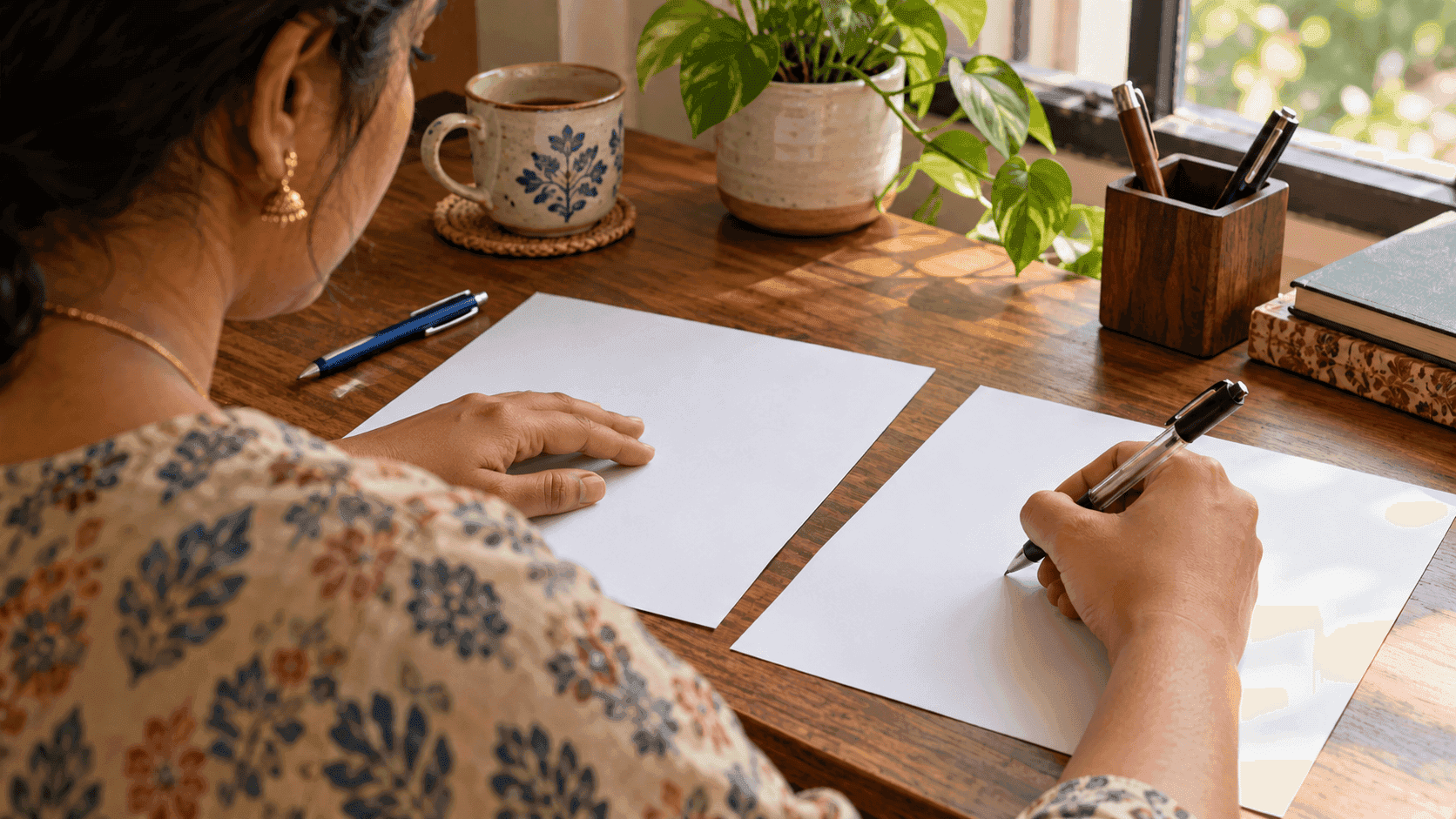
Yesterday's shopping list looks rounded and spacious. Today's notes are smaller, with letters running together. If you are asking why your handwriting changes, first compare the circumstances in which you wrote.
Your pen, paper, pace and purpose can differ between pages. Those differences are worth checking before attaching a personal meaning to the result. You can explore everyday variation by changing one condition at a time and describing what you actually see.
Compare the tasks before comparing the letters
A birthday card and a hurried reminder ask different things of you. On the card, you may deliberately shape each word for someone else to read. In the reminder, getting the information down may matter more than how it looks.
Before comparing two pages, ask what you were doing. Were you copying a sentence, composing a message or catching a detail someone was saying? These tasks are not interchangeable, so the pages are not a controlled comparison.
Notice whether you deliberately changed your style. You might print a name clearly on a label, use joined writing in a notebook and add flourishes to a greeting. None of those examples needs to represent your one authentic handwriting style.
Compare similar text where possible. A page full of numbers will look different from a paragraph with long words and repeated loops. Even the same sentence gives you a clearer basis for comparison than two unrelated pieces of writing.
Keep your description specific. “The spaces between these words are narrower” is an observation you can check. “I was less confident that day” is an interpretation that the spacing cannot establish.
Check the pen, page and writing surface
Start with the tools you used. A broad pen can leave a different-looking line from a fine one, even when you aim for the same letter shape. Ink flow, a worn pencil point and a pen that skips also deserve a look before you judge the writing.
You do not need an expensive pen for this exercise. Use a familiar tool that works consistently, then compare it with another one you already own. Note which pen you used so you do not mistake a tool difference for a personal change.
Look at the paper as well. Ruled lines provide a visible guide that a blank page does not. A narrow notebook and a large sheet also give you different amounts of space, which may influence how you arrange the words.
Check whether the page was supported. Writing at a desk is a different setup from balancing a small notebook on your lap. A raised notebook binding or a cluttered surface can also change the space available for your hand.
The School Curriculum and Standards Authority's handwriting guidance highlights the importance of a suitable pen, writing position and a steady page. Its practical focus is legibility, not personality interpretation.
For your comparison, choose a clear surface and enough room for the page. Keep the setup similar on both attempts. The point is to remove obvious differences, not to find one perfect posture or force an unfamiliar grip.
Notice pace and attention without guessing your mood
You may give letter formation more attention at the start of a page than while trying to capture a complete idea. Instead of assuming why a later line looks different, check what you were asking yourself to do at that moment.
Were you trying to finish before leaving the house? Were you copying carefully, then switching to your own words? Did you stop and return to the notebook later? These details provide context without claiming that a particular slant reveals a particular feeling.
Try writing a short sentence at your ordinary pace. Then write it again slowly enough to pay attention to the spaces and letter endings. Compare the results, but do not assume the slower version is more genuine or more desirable for every task.
A quick personal reminder needs to be understandable when you return to it. A note for someone else needs to be clear to that reader. Judge each page against its purpose rather than expecting every piece of writing to resemble a carefully prepared card.
If you want to record how you felt while writing, label that as your own account. “I remember feeling rushed” is different from “This writing proves I was rushed”. The page alone cannot confirm the cause of a change.
Run a small comparison instead of collecting endless samples
Choose one question you can investigate, such as whether two pens produce different-looking letter edges. Keep the paper, sentence and writing position the same. Write a few lines with each pen and note the difference you were checking.
For a second comparison, keep the pen and sentence fixed and change the paper. Avoid changing the tool, surface and pace together. If several things change at once, you will have less basis for deciding which one mattered.
Use a simple record with four details:
- The sentence or short passage you wrote.
- The one condition you changed.
- The visible difference you noticed.
- What you still cannot explain.
You might observe that one pen leaves thicker strokes while the spacing remains similar. That is a limited, useful finding. It does not show that the pen changed your confidence or that one version expresses your personality more accurately.
Keep the exercise short and stop once it answers your practical question. You do not need to catalogue every letter or repeatedly reproduce an unusually neat page. Ordinary writing does not have to be identical each time to serve its purpose.
Keep handwriting reflection separate from proof
If you are interested in handwriting-based reflection, include the writing context in the discussion. SoulEra's handwriting analysis service describes a natural sample and a report intended for self-awareness. Ask how an observation is being interpreted, and compare any suggested theme with your own experience.
Handwriting interpretations are not validated measures of personality or future behaviour. A graphologist cannot establish your mood from one altered letter, and a difference between two pages does not prove personal growth or decline. You remain free to question or reject an interpretation.
Start with the simplest comparison: what changed in the task, tools or setting? Describe the page before explaining it. A useful outcome is understanding which conditions make your writing clearer for its purpose, without turning every variation into a judgement about yourself.