
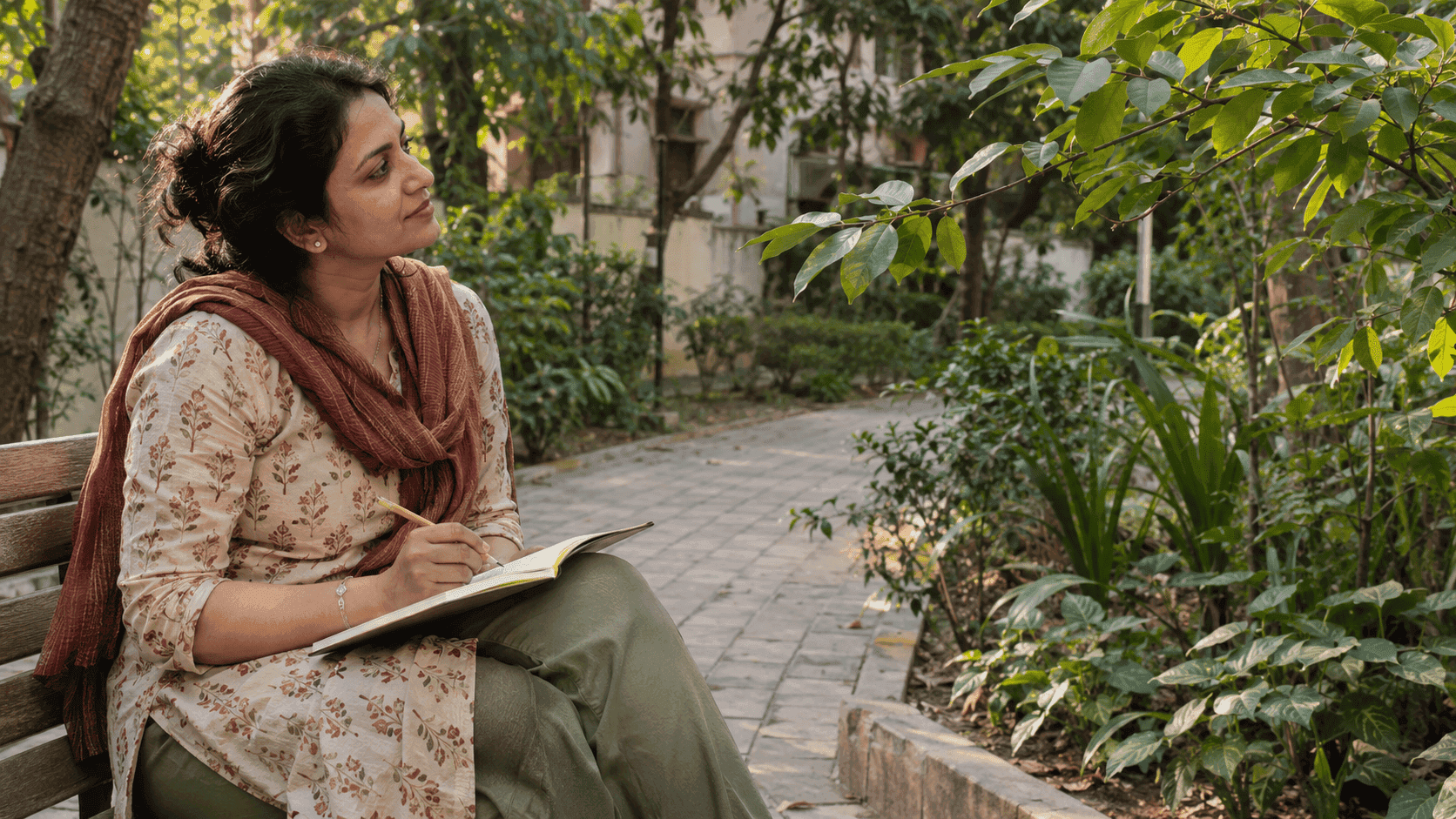
You notice a leaf turning in the breeze, then hesitate over your notebook because you cannot draw it properly. Start with the words you already have: pale underneath, pointed tip, moving while the branch stays still.
Nature journaling for beginners can begin with a few observations from one familiar spot. You need somewhere to record them, something to write with and a little curiosity. Drawing skills and species names can wait. The first useful page is one you can return to and understand.
Choose a small patch you can revisit
Start close to home: a tree visible from your window, a corner of a shared garden or a planter beside a familiar path. Choose somewhere you can observe safely and comfortably, with permission where needed. A long journey or dramatic landscape is unnecessary.
Keep the area small enough to describe. “The garden” might contain more than you can follow. “The low branch beside the bench” gives your next visit a recognisable starting point. You can explore further once you have made a few entries.
Note where you are looking from. A window, bench or path gives you a consistent viewpoint, although you do not have to return at precisely the same time. If the viewpoint changes, record that too. It helps explain why different details may be visible.
Use a notebook you already have. A pencil and a firm backing may be convenient outdoors; a few notes on your phone are also fine if paper is awkward. Start with a format that fits how you can comfortably observe.
Stay on permitted paths and leave plants and animals undisturbed. You can describe something without picking it, moving it or approaching it closely. If conditions make the visit uncomfortable, stop and return another time or watch from indoors.
Build an entry from details you can check
Put the date, approximate time and place at the top. Add a few words about the conditions you notice, such as bright light, a grey sky or leaves moving in short bursts. You do not need instruments or a weather report to describe what is visible.
Then choose one subject. Look for shape, colour, position or movement. Instead of “a beautiful leaf”, try “a narrow leaf with a pointed tip; the underside looks paler when it turns”. Your own ordinary words can preserve details that a general compliment leaves out.
A simple first entry could include:
- Where I looked: The lower branch beside the garden bench.
- What I saw: Five leaves visible at the tip; one has a brown edge.
- What moved: The outer leaves turned back and forth while I watched.
- What I wonder: Will that brown edge look different on my next visit?
This is an invented example, not a report about a particular plant. Adapt the structure to what you can actually observe. If you count five visible leaves, keep “visible” in the note rather than claiming the branch has only five.
You can record sounds too. “Three short calls from beyond the wall” is useful even when you cannot see what made them. Keep the source unknown unless you have enough information to identify it.
End with one question you could revisit. “What changes here?” is broad. “Does the same branch look different from this bench in the morning?” gives your next entry a clear focus.
Use rough marks and leave unknowns visible
A sketch can simply show where things are. Use a line for the branch, loose ovals for the leaves and an arrow towards the brown edge. Add labels when a shape does not communicate enough. You are making a record for yourself, so an imperfect outline can still be useful.
Try drawing only the part that interests you. There is no need to fit the whole tree onto the page. A rough edge, a branching shape or the position of a shadow may be enough. Words can do the rest.
If you prefer not to draw, describe the arrangement: “Three leaves close together, then a gap before the next pair.” A quick photograph can sit alongside your notes, but add what you were paying attention to. Later, the image alone may not explain why you took it.
Keep observation and explanation separate. “There is a hole in the leaf” records something visible. “An insect ate it” is an explanation you have not necessarily established. Write a question mark or add “I wonder whether…” instead of turning a guess into a fact.
You do not have to identify the plant to continue. A temporary label such as “plant by the blue pot” lets you find it again. If you later confirm a name through a reliable source, add that information with the source and date rather than rewriting your original uncertainty.
Compare visits and notice what interests you
On your next visit, make a fresh note before rereading the earlier page. Then compare the two. What looks similar? What seems different? What did you overlook before? Keep the answers tied to the same small patch wherever possible.
Check the conditions before concluding that the subject changed. A different viewing angle, stronger light or a partly hidden branch may affect what you can see. Write “I can see more of the pale underside today” if that is all you know. You can leave the reason open.
If a detail is missing, record that carefully too. “I did not hear the calls during this visit” is more accurate than deciding the source has disappeared. Your entry covers the time you spent there, not everything happening in the area.
Alongside these comparisons, notice what you choose to record. Perhaps you keep writing about movement and rarely mention colour. Perhaps questions interest you more than sketches. These are preferences within your current practice, not evidence of a fixed personality or special ability.
Try a handwritten closing line: “The detail I wanted to stay with today was…” On another visit, deliberately give a different detail some attention. Compare whether you enjoyed that approach. The content of the note can guide your next experiment; the neatness, slant or pressure of your writing does not explain what kind of person you are.
Make the next visit easy
Leave your notebook somewhere convenient and return to the same spot when it fits your day. Record one detail, one uncertainty and anything you want to look for again. A few readable lines are enough. Over time, you will have pages you can compare, with room for rough marks, unanswered questions and the things you happened to notice.